
गैर आवासीय नेपाली संघ हङकङ लिमिटेड
香 港 非 居 住 尼 泊 爾 人 協 會 有 限 公 司
Non-Resident Nepalese Association Hong Kong Limited

Veteran Beekeeper Earns Notable Income
PARBAT, Nepal — At 73, Tika Ram Timilsina of Modi Rural Municipality-2, Korunga, has emerged as a distinguished practitioner of commercial apiculture in Parbat district, leveraging two-and-a-half decades of experience to sustain a remunerative enterprise despite mounting environmental challenges.
Timilsina, once renowned locally for extensive orange cultivation, transitioned to beekeeping after a decline in his citrus orchard. He now manages 35 hives of the hill-adapted Apis cerana, producing approximately 200 kilograms of honey annually and marketing his product at NPR 1,500 per kilogram. At the zenith of his operations, annual revenues approached NPR 1.5 million, underscoring the economic potential of apiculture in the region.
Local demand for Timilsina’s honey remains robust, with regular buyers drawn from village households, municipal offices and traders from larger markets such as Kathmandu, Chitwan and Butwal. His farm has also become a source of nucleus colonies and hives distributed through municipal support programmes and agricultural extension services, reflecting growing institutional recognition of apiculture’s value.
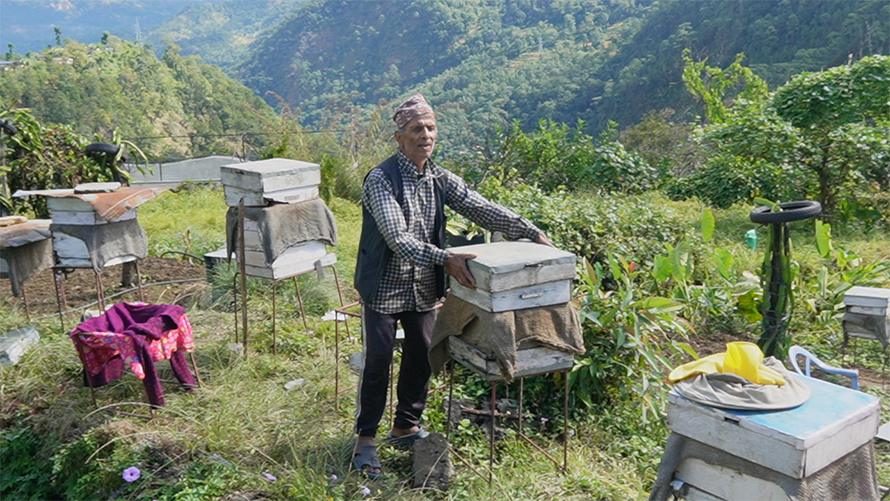
Despite commercial gains, Timilsina reports significant adversities. He cites climate variability, incursions by predatory insects and hornets, and land-use constraints as principal factors undermining productivity. Last year’s catastrophic landslide, which swept into his courtyard, and extensive hornet predation destroyed numerous hives, illustrating the sector’s vulnerability to natural hazards.
Agricultural officials say apiculture requires relatively modest initial capital compared with other agrarian enterprises and yields attractive returns without the continuous labour intensity of vegetable or poultry farming. “Beekeeping’s favourable risk-to-reward profile is catalysing broader adoption among farmers across Deupur, Mallaj, Bhangra and neighbouring communities,” a regional agronomist observed.
Timilsina’s operation not only supplies commercial markets but also serves as a practical model for local farmers seeking diversification. He has sold over a hundred nucs and hives in collaboration with the Agricultural Knowledge Centre and the rural municipality, reinforcing his role as both producer and local resource person.
As Parbat’s beekeeping community expands, experts caution that bolstering resilience will require targeted measures: improved pest management, slope stabilization to mitigate landslide risk and adaptive practices to cope with shifting climatic patterns. For now, Timilsina’s sustained enterprise demonstrates how adaptive diversification can yield tangible livelihoods even in marginal hill environments.
Timilsina, once renowned locally for extensive orange cultivation, transitioned to beekeeping after a decline in his citrus orchard. He now manages 35 hives of the hill-adapted Apis cerana, producing approximately 200 kilograms of honey annually and marketing his product at NPR 1,500 per kilogram. At the zenith of his operations, annual revenues approached NPR 1.5 million, underscoring the economic potential of apiculture in the region.
Local demand for Timilsina’s honey remains robust, with regular buyers drawn from village households, municipal offices and traders from larger markets such as Kathmandu, Chitwan and Butwal. His farm has also become a source of nucleus colonies and hives distributed through municipal support programmes and agricultural extension services, reflecting growing institutional recognition of apiculture’s value.
Agricultural officials say apiculture requires relatively modest initial capital compared with other agrarian enterprises and yields attractive returns without the continuous labour intensity of vegetable or poultry farming. “Beekeeping’s favourable risk-to-reward profile is catalysing broader adoption among farmers across Deupur, Mallaj, Bhangra and neighbouring communities,” a regional agronomist observed.
Timilsina’s operation not only supplies commercial markets but also serves as a practical model for local farmers seeking diversification. He has sold over a hundred nucs and hives in collaboration with the Agricultural Knowledge Centre and the rural municipality, reinforcing his role as both producer and local resource person.
As Parbat’s beekeeping community expands, experts caution that bolstering resilience will require targeted measures: improved pest management, slope stabilization to mitigate landslide risk and adaptive practices to cope with shifting climatic patterns. For now, Timilsina’s sustained enterprise demonstrates how adaptive diversification can yield tangible livelihoods even in marginal hill environments.